
By VagabondOptics - Own work, CC BY-SA 3.0, Link
How It Started
When exactly punk started, and whether or not it's "dead," are questions outside the scope of any one blog post. But the beginnings of punk fashion are a little bit easier to pinpoint.
When Malcolm McLaren started managing the Sex Pistols in 1974, he was also running a London clothing shop with his girlfriend, Vivienne Westwood. The shop was called "Sex," and it was arguably the biggest influence on the early punk look: ripped T-shirts, safety pins, scrawled slogans, and leather. Of course, the original punks didn't just buy their fashion: they created it themselves, spray-painting and patching their T-shirts and jackets to express their individuality and commitment to the scene.
Punk music had started (again, arguably) with New York bands the Ramones and the New York Dolls before the English scene popularized it. But as punk moved back across the Atlantic in the late 1970s and early 1980s, many disaffected and talented young musicians took the rebellious do-it-yourself musical ethos of the English punks and made it faster, simpler, more aggressive, and more thoughtful.
In other words, hardcore was born.
How Hardcore Adopted the Graphic Tee
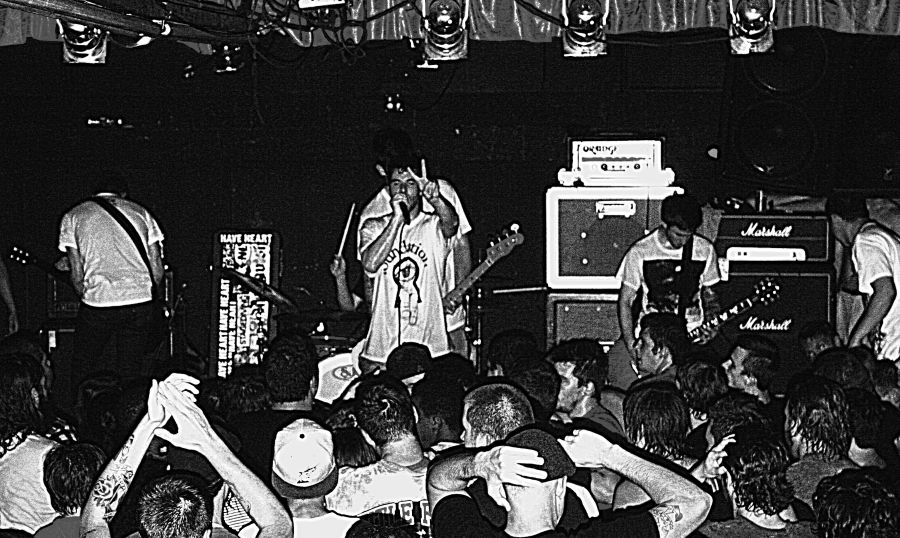
In contrast to the increasingly complex fashion of the, we might say, slightly more mainstream punk rockers (studs, mohawks, piercings, and so on), the hardcore punks of the 1980s and 1990s kept things understated: crew-neck tees, tank tops, shorts or jeans, shorter hair, and in general, a look that would allow you to move and exert yourself easily in the course of a show. Hardcore bands produced their own merch, so the slogans on the shirts were now screen-printed rather than spray-painted. And the connection between hardcore and graphically printed tees that allow for athletic movement has been strong ever since.
Anyone who's been in a band or been to a hardcore show knows that the relationship between hardcore and graphic tees is partially practical. Hardcore shows offer cheap tickets by design, so there's never much gate. To pay for their tours and pay the rent, bands need to sell merch. You can only sell so many CDs and cassette tapes, and the margins on those often aren't great. T-shirts and long sleeve tees, in contrast, are easy to produce. There's a need on the customer side: not everyone needs yet another EP, but everyone could use another shirt. And the opportunity for branding or customizing a shirt with a band's own design is almost endless.
For the kids at the show, the screen-printed band T-shirt is not just a chance to show their individuality or their commitment to hardcore values: it gives them a foothold in the scene, demonstrating that they're willing to put up their cash in order to support what a band is doing. And maybe you should, too, next time the band is in town touring.
From the young punk spraypainting his or her own T-shirt designs in a garage to the scrappy band living off the margins of their screen-printed T-shirt sales, graphic tees have a long and storied history in the hardcore scene. It's been a mutually beneficial relationship.
The designs of Zero Breath Clothing's T-shirts and long sleeve tees are inspired by this legacy of DIY creativity and commitment. They express not just our love for the water, but our love for those who commit themselves to a set of values that are beyond the typical. They're shirts for those who want to push themselves a little deeper, a little further, and a little longer in the water. They're shirts. Check them out here.